What Happens If You Don't Pay Quarterly Taxes? Penalties, Interest, and How to Fix It
The IRS charges ~8% annual interest on late quarterly payments, calculated per quarter. Here's exactly what you owe, how penalties work, and how to catch up.
If you are self-employed and do not make quarterly estimated tax payments, the IRS charges an underpayment penalty of approximately 8% annually (the rate adjusts quarterly based on the federal short-term rate plus 3 percentage points). The penalty is calculated independently for each quarter — paying everything in Q4 does not eliminate penalties for missing Q1 through Q3. The penalty applies even if you receive a refund for the year, because each quarter is treated as a separate obligation.
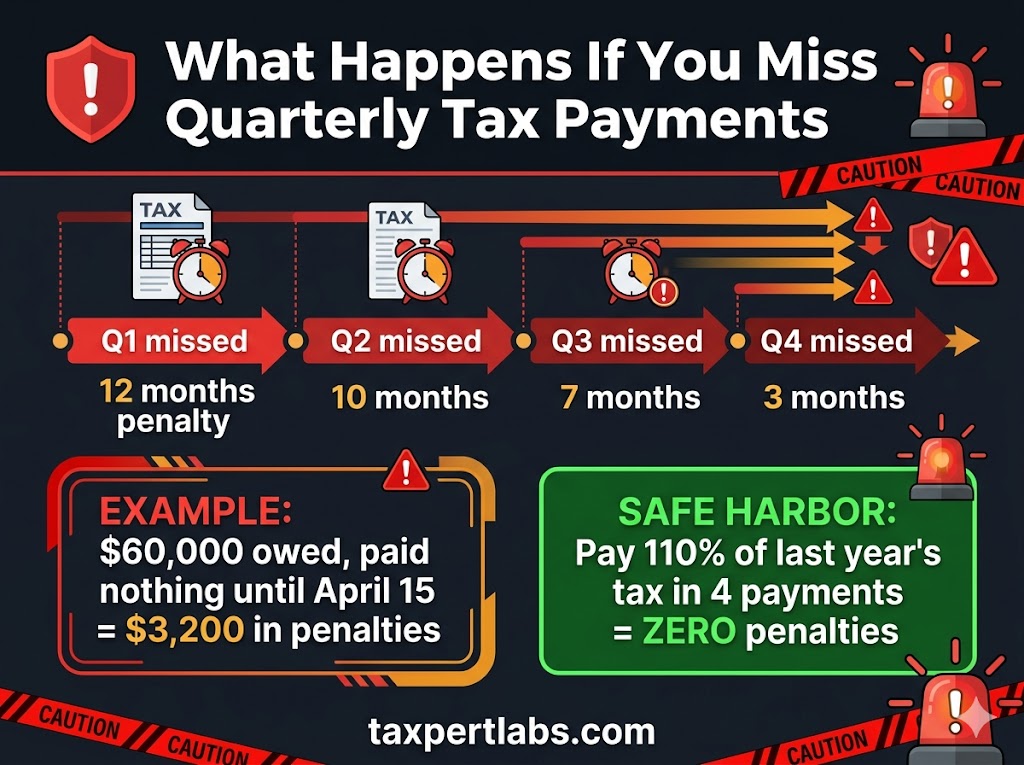
How the underpayment penalty is calculated
The IRS calculates the penalty for each quarter separately using Form 2210. For each quarter, the penalty runs from the payment due date to whichever comes first: the date you actually pay, or April 15 of the following year.
| Quarter | Due Date | Penalty Period If Unpaid |
|---|---|---|
| Q1 | April 15 | Apr 15 → Apr 15 next year (12 months) |
| Q2 | June 16 | Jun 16 → Apr 15 next year (10 months) |
| Q3 | September 15 | Sep 15 → Apr 15 next year (7 months) |
| Q4 | January 15 | Jan 15 → Apr 15 (3 months) |
Example: You owe $15,000 per quarter ($60,000 total) and pay nothing until April 15 the next year. At 8% annually: Q1 penalty = $15,000 x 8% x 12/12 = $1,200. Q2 = $1,000. Q3 = $700. Q4 = $300. Total penalty: approximately $3,200.
The two safe harbors that eliminate all penalties
Meet either one and you owe zero penalty regardless of what you actually owe:
- Prior year safe harbor: Pay 100% of last year's total tax liability in four equal quarterly payments. If your AGI was over $150,000, the threshold is 110%. This is the simplest approach — no forecasting needed.
- Current year safe harbor: Pay 90% of the current year's tax liability across four quarters. Requires accurate income forecasting.
How to catch up if you have already missed payments
- Pay what you owe immediately — the penalty stops accruing on the date you pay
- Continue making remaining quarterly payments on time
- Consider the annualized income installment method (Form 2210, Schedule AI) if your income was uneven — this can reduce or eliminate penalties for quarters where your income was lower
- File your return on time even if you cannot pay the full amount — the failure-to-file penalty (5%/month) is much worse than the failure-to-pay penalty
Use our SE Tax Calculator to see your quarterly payment amounts. For the complete guide, read our Quarterly Estimated Taxes Guide.
Want to reduce your quarterly payments by 40-60%? Run your free tax assessment to see which strategies lower your total tax liability.
See How Much You're Overpaying
Run a free 2-minute assessment and get your personalized tax leak report — with IRS-backed strategies and IRC code citations.
Run My Free Assessment