Quarterly Estimated Taxes in Florida: The Self-Employed Guide to Avoiding Penalties
Miss a quarterly payment and the IRS charges you interest — even if you overpaid for the year. Here's exactly when to pay, how much, and how to reduce what you owe.
Quarterly estimated taxes are required for any self-employed individual in Florida who expects to owe $1,000 or more in federal taxes. Since Florida has no state income tax, you only make federal payments — but missing them triggers penalties even if you overpay for the year. The IRS calculates penalties on each quarter independently, which means paying everything in Q4 still results in penalties for Q1-Q3.
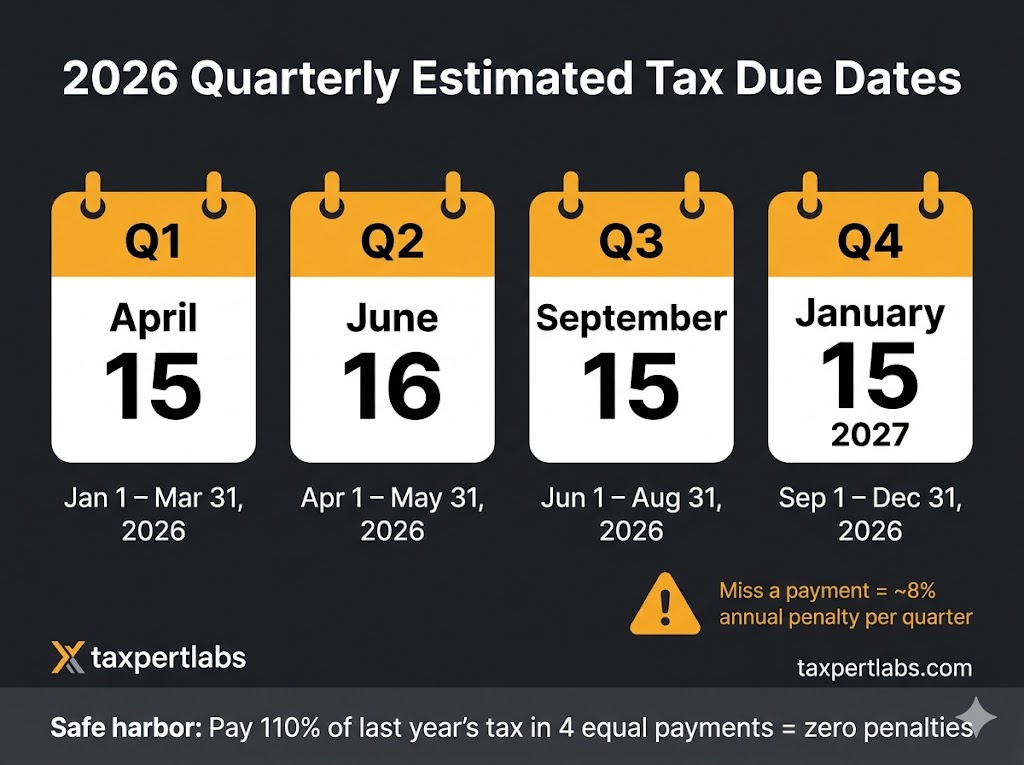
2026 Quarterly Due Dates
| Quarter | Period Covered | Due Date |
|---|---|---|
| Q1 | January 1 – March 31 | April 15, 2026 |
| Q2 | April 1 – May 31 | June 16, 2026 |
| Q3 | June 1 – August 31 | September 15, 2026 |
| Q4 | September 1 – December 31 | January 15, 2027 |
How Much to Pay: The Safe Harbor Rule
The IRS provides two safe harbors — meet either one and you avoid all underpayment penalties regardless of what you actually owe:
- Option 1 (easiest): Pay 110% of last year's total tax liability, divided into 4 equal payments. If you paid $50,000 in 2025, pay $55,000 in 2026 ($13,750/quarter). This works even if your income doubles — no penalty.
- Option 2: Pay 90% of this year's tax liability across the 4 quarters. Requires more accurate forecasting but results in lower payments if income drops.
For most Florida self-employed professionals, Option 1 is the right choice. It requires zero forecasting and guarantees no penalties. If you overpay, you get a refund.
How to Calculate Your Quarterly Payment
For a self-employed Florida professional earning $200,000:
| Tax Component | Annual Amount | Quarterly Payment |
|---|---|---|
| Federal income tax | ~$35,000 | $8,750 |
| Self-employment tax | ~$24,000 | $6,000 |
| Total | ~$59,000 | $14,750 |
| Safe harbor (110%) | ~$64,900 | $16,225 |
How to Reduce Your Quarterly Payments
The best way to reduce estimated payments is to reduce your tax liability. Every strategy that lowers your annual tax also lowers your quarterly payments:
- S-Corp election (IRC §1361): Saves $10,000-$25,000/year in SE tax → quarterly payments drop $2,500-$6,250
- Solo 401(k) (IRC §401(k)): Shelter up to $69,000 → quarterly payments drop up to $6,000
- Home office deduction (IRC §280A): Deduct $3,000-$6,000 → quarterly payments drop $250-$500
- HSA contributions (IRC §223): Deduct $4,300-$8,750 → quarterly payments drop $350-$700
An S-Corp election alone can reduce your quarterly payment by $2,500-$6,250 — that's real cash flow every 3 months.
How to Pay
Three options:
- IRS Direct Pay (irs.gov/payments) — free, instant, no account needed
- EFTPS (eftps.gov) — requires enrollment, best for recurring payments
- Mail Form 1040-ES with a check — slowest option, not recommended
Use payment type "Estimated Tax" and select the correct tax year and quarter.
Want to see exactly how much your quarterly payments should be based on your specific situation? Run your free tax assessment — it calculates your optimized tax liability and shows you how much each strategy saves per quarter.
Related Reading
See How Much You're Overpaying
Run a free 2-minute assessment and get your personalized tax leak report — with IRS-backed strategies and IRC code citations.
Run My Free Assessment