1099 Tax Strategies for Florida Independent Contractors: How to Keep $30,000-$90,000 More Per Year
Florida 1099 contractors overpay an average of $47,000/year in taxes. Here are the exact IRS strategies — with code sections — that cut your tax bill by 40-60%.
If you're a 1099 independent contractor in Florida making $150,000 or more, you're almost certainly overpaying your taxes. Not by a little — by $30,000 to $90,000 per year.
Florida's lack of state income tax is a massive advantage. But most contractors stop there and never optimize their federal tax situation. They file a Schedule C, pay the full 15.3% self-employment tax on every dollar, take the standard deduction, and call it a day.
That's not tax strategy. That's tax filing. And it's costing you tens of thousands of dollars every year.
What a 1099 Contractor Actually Owes (Before Any Strategies)
Let's look at the real numbers for a Florida 1099 contractor earning $300,000:
| Tax Component | Amount |
|---|---|
| Social Security Tax (12.4% on $168,600) | $20,906 |
| Medicare Tax (2.9% on $277,050) | $8,034 |
| Additional Medicare (0.9% over $200K) | $693 |
| Total Self-Employment Tax | $29,633 |
| Federal Income Tax (after SE deduction) | ~$56,000 |
| Total Federal Tax | ~$85,633 |
| Effective Tax Rate | 28.5% |
That's $85,633 to the IRS on $300,000 of income. And that's with Florida's zero state tax advantage already built in.
Now let's fix it.
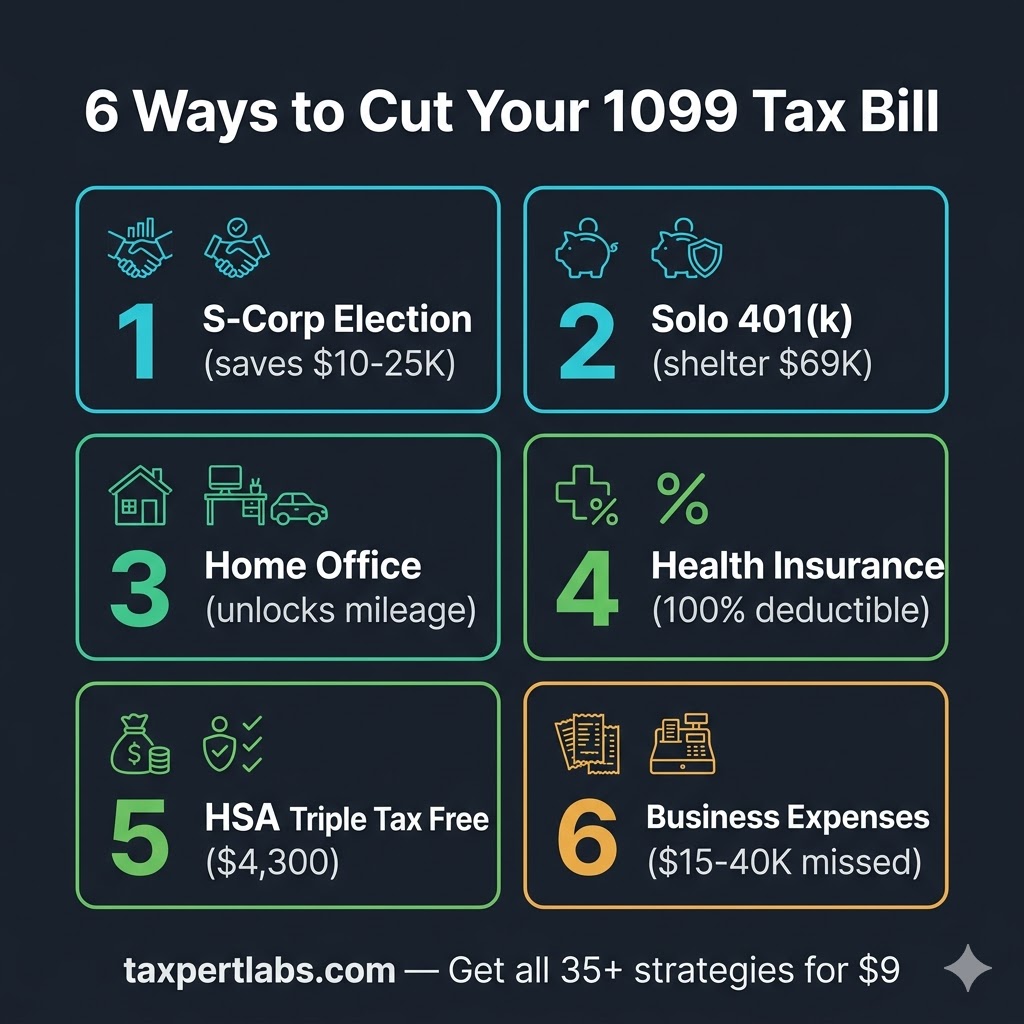
Strategy 1: S-Corp Election — Save $10,000-$25,000/Year
IRC §1361-1379
This is the single highest-impact move for any 1099 contractor. When you elect S-Corp taxation on your LLC, you split your income into two categories:
- Reasonable salary (W-2) — subject to FICA taxes
- Shareholder distributions — NOT subject to self-employment tax
On $300,000 in income with a $120,000 reasonable salary:
| Sole Prop / LLC | S-Corp | |
|---|---|---|
| FICA/SE tax base | $277,050 | $120,000 |
| Total FICA/SE tax | $29,633 | $18,360 |
| Annual savings | $11,273 |
The S-Corp election saves $11,273/year on $300K income. On $450K+ income, the savings exceed $20,000/year. This is not aggressive — it's the most widely used tax strategy for self-employed professionals in America.
How to do it: Form an LLC in Florida (sunbiz.org, $125), then file IRS Form 2553 to elect S-Corp taxation. Set up payroll through Gusto or ADP. Pay yourself a reasonable salary based on industry data.
Strategy 2: Solo 401(k) — Shelter $55,500-$69,000 From Taxes
IRC §401(k)
The Solo 401(k) is the most powerful retirement vehicle for self-employed individuals. You can contribute up to $69,000 per year ($76,500 if age 50+) — far more than a traditional IRA ($7,000) or a regular employer 401(k).
With an S-Corp paying $120,000 salary:
- Employee deferral: $23,000
- Employer contribution (25% of $120K): $30,000
- Total: $53,000 sheltered from taxes
At a 32% marginal rate, that's $16,960 in tax savings — plus the money grows tax-deferred for decades.
Key deadline: The plan must be established by December 31 of the tax year. Contributions can be made up to the tax filing deadline (including extensions). If you missed the December 31 deadline, a SEP IRA is your backup — it can be opened and funded up to the filing deadline.
Strategy 3: Home Office Deduction — Unlock All Business Mileage
IRC §280A(c)(1)
The home office deduction itself saves $1,500-$6,000/year depending on your rent or mortgage. But the real value is what it unlocks: when your home is your principal place of business, all driving from home becomes deductible business mileage.
Without a home office, driving from home to your first client meeting is "commuting" — not deductible. With a home office, that same drive is a business trip.
For a contractor driving 25,000 business miles per year at $0.70/mile, that's a $17,500 deduction — saving $5,600 at the 32% bracket.
Requirements: Dedicated space used exclusively and regularly for business. Take photos, measure square footage, and keep it documented.
Strategy 4: Health Insurance Deduction
IRC §162(l)
Self-employed individuals can deduct 100% of health insurance premiums above the line. This is not an itemized deduction — it reduces your AGI directly, which lowers your tax across the board.
For an S-Corp owner: the S-Corp pays or reimburses your premiums, includes the amount on your W-2 (Box 1 only, not Boxes 3 and 5), and you deduct it on your personal return. Estimated savings: $2,000-$4,000/year.
Strategy 5: HSA — The Triple Tax Advantage
IRC §223
If you have a High-Deductible Health Plan (HDHP), the Health Savings Account is the only account in the tax code with three simultaneous tax benefits:
- Tax-deductible contributions (reduces AGI)
- Tax-free investment growth
- Tax-free withdrawals for qualified medical expenses
No IRA, 401(k), or Roth has all three. Contribution limits for 2025: $4,300 (self-only) or $8,750 (family). The optimal strategy: contribute the maximum, pay medical expenses out of pocket, invest the HSA in growth assets, and let it compound tax-free for decades.
Strategy 6: Business Expense Maximization
IRC §162
Most 1099 contractors claim some business deductions. Few claim all of them. Common deductions left on the table by Florida contractors:
| Expense | Typical Annual Amount |
|---|---|
| Phone + internet (business %) | $2,000-$3,600 |
| Software + subscriptions | $2,000-$5,000 |
| Professional development + courses | $2,000-$8,000 |
| Professional liability insurance | $1,500-$5,000 |
| Marketing + advertising | $3,000-$15,000 |
| Business meals (50% deductible) | $2,000-$6,000 |
| Business travel | $3,000-$10,000 |
| CPA + legal fees | $3,000-$8,000 |
Total commonly missed deductions: $20,000-$60,000/year. At a 32% bracket, that's $6,400-$19,200 in additional tax savings.
The rule is simple: if it's ordinary and necessary for your business, it's deductible. Document everything — keep receipts, note the business purpose, and track it in a bookkeeping system.
Strategy 7: QBI Deduction — 20% Off Your Business Income
IRC §199A
The Qualified Business Income deduction allows pass-through business owners to deduct 20% of their qualified business income. For a contractor with $200,000 in QBI, that's a potential $40,000 deduction.
Important limitations: If you're in a Specified Service Trade or Business (SSTB) — which includes consulting, financial services, law, health, and accounting — the deduction phases out above $191,950 (single) and disappears entirely above $241,950. Industries like construction, real estate, insurance sales, engineering, and architecture are NOT SSTBs and keep the full deduction regardless of income.
If you qualify, the QBI deduction is worth more than almost any other single strategy on this list. Have your CPA verify your SSTB status.
Strategy 8: Backdoor Roth IRA — Tax-Free Growth Forever
IRC §408A
High-income 1099 contractors can't contribute directly to a Roth IRA (income limits). But the backdoor Roth conversion works at any income level:
- Contribute $7,000 to a non-deductible Traditional IRA
- Immediately convert to a Roth IRA
- Pay approximately $0 in tax on the conversion (no pre-tax IRA balance)
The money grows tax-free forever. At age 30, $7,000/year at 8% returns becomes $1.1 million tax-free by age 65. Do this every year without exception.
The Full Stack: What a $300K Florida Contractor Saves
| Strategy | Annual Tax Savings |
|---|---|
| S-Corp Election | $11,273 |
| Solo 401(k) ($53,000) | $16,960 |
| Business Expenses ($35,000) | $11,200 |
| Vehicle Mileage ($17,500) | $5,600 |
| Home Office ($5,000) | $1,600 |
| Health Insurance ($8,000) | $2,560 |
| HSA ($4,300) | $1,376 |
| QBI Deduction (if eligible) | $12,800 |
| Total Annual Savings | $63,369 |
Before strategies: $85,633 in federal tax (28.5% effective rate)
After strategies: ~$22,264 in federal tax (7.4% effective rate)
That's $63,369 kept — every year — using the same IRS rules that high-net-worth individuals use with their tax attorneys.
What to Do This Week
- Form your LLC at sunbiz.org ($125) and file Form 2553 for S-Corp election
- Open a Solo 401(k) at Fidelity or Schwab (free, takes 15 minutes online)
- Set up payroll through Gusto ($40/month) with your reasonable salary
- Document your home office — photos, measurements, exclusive use
- Install a mileage tracker — MileIQ or Everlance on your phone today
- Run your free tax assessment at taxpertlabs.com/free-analysis to see your complete strategy stack ranked by savings
Every month you wait costs you an estimated $2,500-$8,000 in taxes you don't owe. The strategies above are not loopholes — they're the same IRS rules that wealthy Americans use every year. The only difference is whether you know about them.
Related Reading
See How Much You're Overpaying
Run a free 2-minute assessment and get your personalized tax leak report — with IRS-backed strategies and IRC code citations.
Run My Free Assessment