The Home Office Deduction in Florida: How South Florida Self-Employed Professionals Save $2,000–$5,000/Year
Working from home in Fort Lauderdale, Boca Raton, or Miami? The IRS home office deduction lets you write off a portion of your rent, mortgage, utilities, and internet — if you follow the rules.
If you're self-employed in South Florida and work from home — even part of the time — you're likely missing one of the most straightforward tax deductions available. The home office deduction lets you write off a percentage of your housing costs, and in a market like Fort Lauderdale, Boca Raton, or Miami where rents and mortgages are high, the savings add up fast.
Yet most people either skip it (afraid of audits) or claim it wrong (missing thousands). Here's the real breakdown.
Who Qualifies for the Home Office Deduction?
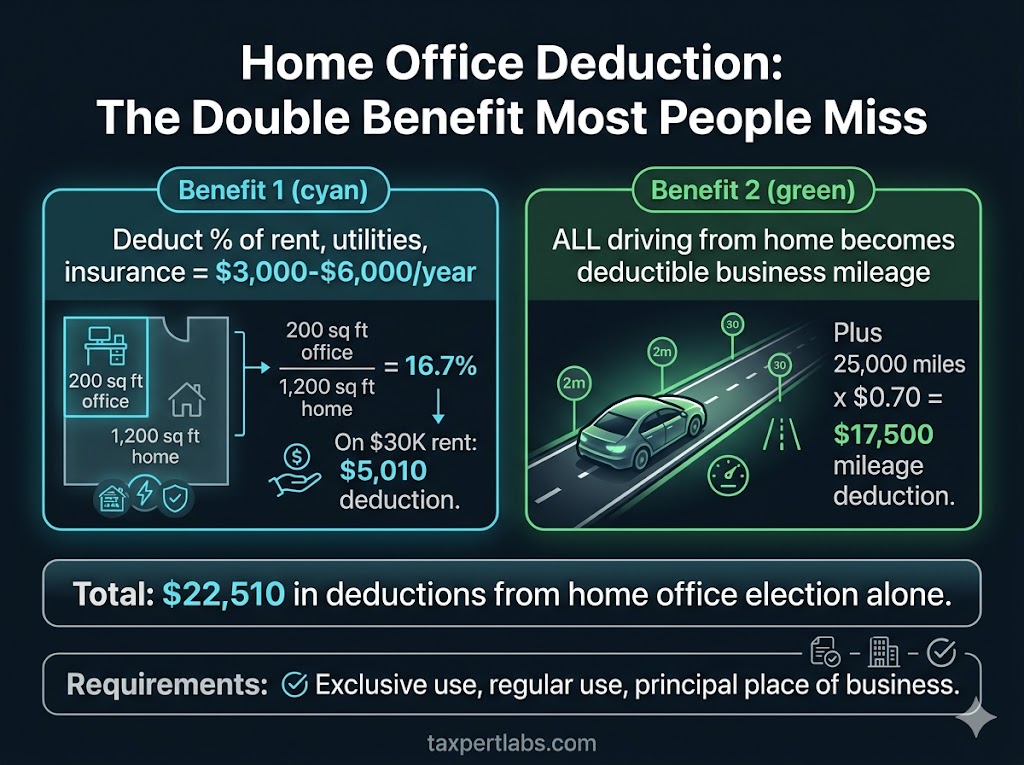
You qualify if you meet both of these IRS requirements:
- Regular and exclusive use: A specific area of your home is used only for business — not as a guest room, not as a TV room. It doesn't have to be a full room — a dedicated desk area or converted closet counts.
- Principal place of business: It's where you do most of your work, OR where you meet clients/customers. If you work from a co-working space sometimes but do most of your work from home, you still qualify.
Important: This deduction is for self-employed individuals only (sole proprietors, single-member LLCs, independent contractors). If you're a W-2 employee working from home, you cannot claim this deduction under current tax law (changed in 2018 with the TCJA).
Two Methods: Simplified vs. Regular
The IRS gives you two ways to calculate the deduction. You can switch between them each year.
Method 1: Simplified Method
- $5 per square foot of your home office, up to 300 sq ft
- Maximum deduction: $1,500/year
- No receipts or calculations needed
- Cannot deduct home depreciation
This is easy but leaves money on the table for most South Florida professionals — especially with how expensive housing is here.
Method 2: Regular (Actual Expense) Method
Calculate the percentage of your home used for business, then apply that percentage to your actual housing expenses:
- Mortgage interest or rent
- Property taxes
- Homeowners/renters insurance
- Utilities (electric, water, gas)
- Internet service
- Home repairs and maintenance
- Depreciation (if you own)
The percentage is calculated as: (Square footage of office) ÷ (Total square footage of home)
The Math for a Typical South Florida Professional
Let's say you're a freelance consultant in Fort Lauderdale. You rent a 1,500 sq ft apartment for $3,200/month and use a dedicated 200 sq ft office. That's 13.3% of your home.
| Expense | Annual Total | Deductible (13.3%) |
|---|---|---|
| Rent | $38,400 | $5,107 |
| Electric | $3,600 | $479 |
| Internet | $1,200 | $160 |
| Renters insurance | $600 | $80 |
| Total deduction | $5,826 |
Compare that to the simplified method's $1,000 (200 sq ft × $5). The regular method saves you almost 6x more.
At a 32% tax bracket, that $5,826 deduction saves you $1,864 in federal income tax — plus it reduces your self-employment tax by another $824. Total savings: $2,688/year.
If you own your home, add mortgage interest and depreciation — the deduction can easily hit $5,000–$8,000+ in South Florida's real estate market.
South Florida Homeowner Bonus: Depreciation
If you own your home, you can depreciate the business-use portion over 39 years. On a $500,000 Fort Lauderdale condo with 13.3% business use:
- Depreciable basis (building only, not land): ~$375,000
- Business portion: $49,875
- Annual depreciation: ~$1,279
That's an extra $1,279/year in deductions on top of your actual expenses — for doing nothing extra.
Will the Home Office Deduction Trigger an Audit?
This is the #1 myth that stops people from claiming it. Here's the reality:
- The IRS does not automatically flag home office deductions for audit
- What triggers audits is inconsistency — claiming a home office but listing no home expenses, or claiming your entire apartment as an office
- If your deduction is reasonable and well-documented, you have nothing to worry about
- The simplified method carries virtually zero audit risk
The real risk isn't claiming the deduction — it's not claiming it and losing thousands every year.
What You Need to Document
Keep these records in case the IRS ever asks:
- Photos of your home office space (take them once a year)
- Floor plan sketch showing the dedicated area and measurements
- Receipts/statements for rent, mortgage, utilities, insurance, internet
- A log of business use (not required, but helpful if your space does double duty)
Common Mistakes South Florida Professionals Make
- Using the simplified method when the regular method saves more: With South Florida housing costs, the regular method almost always wins. Do the math both ways.
- Counting shared spaces: Your kitchen table doesn't count unless it's exclusively used for business. Get a dedicated desk or room.
- Forgetting internet and utilities: These are deductible too — don't just count rent or mortgage.
- Not claiming it at all: The biggest mistake. If you work from home and you're self-employed, claim it.
- Claiming too much: Don't say 50% of your apartment is an office when it's a corner desk. Be honest — a reasonable claim is a safe claim.
Home Office + Other Deductions = Major Savings
The home office deduction stacks with other strategies. A typical South Florida self-employed professional could combine:
| Strategy | Annual Savings |
|---|---|
| Home office deduction | $2,000–$5,000 |
| S-Corp election | $15,000–$25,000 |
| Solo 401(k) | $10,000–$20,000 |
| HSA contributions | $2,000–$3,000 |
| QBI deduction | $5,000–$10,000 |
| Combined | $34,000–$63,000 |
That's not theoretical — those are real savings available to South Florida business owners right now.
Bottom line: If you work from home in Fort Lauderdale, Boca Raton, Miami, or anywhere in South Florida, you should be claiming the home office deduction. Use the regular method, keep basic documentation, and stop leaving money on the table. Run your free tax assessment to see your total savings across all available strategies.
Related Reading
See How Much You're Overpaying
Run a free 2-minute assessment and get your personalized tax leak report — with IRS-backed strategies and IRC code citations.
Run My Free Assessment