Cost Segregation Studies for Fort Lauderdale Real Estate Investors: How to Create $100,000+ in Year 1 Tax Deductions
A cost segregation study can accelerate $100,000–$500,000 of depreciation into Year 1 on a single South Florida property. Here's exactly how it works and when it makes sense.
If you own real estate in South Florida — a rental condo in Fort Lauderdale Beach, a commercial building in Boca Raton, a short-term rental in Miami — you're sitting on a depreciation deduction you've almost certainly been underutilizing.
Standard depreciation on a residential rental property takes 27.5 years to fully depreciate a building. On a $1.5 million Fort Lauderdale property, that's roughly $54,000 per year in deductions. Fine, but nothing special.
A cost segregation study changes the entire math. By reclassifying components of the building from a 27.5-year schedule to 5, 7, or 15-year schedules — and combining with bonus depreciation — that same property can generate $200,000 to $400,000 in deductions in Year 1 alone.
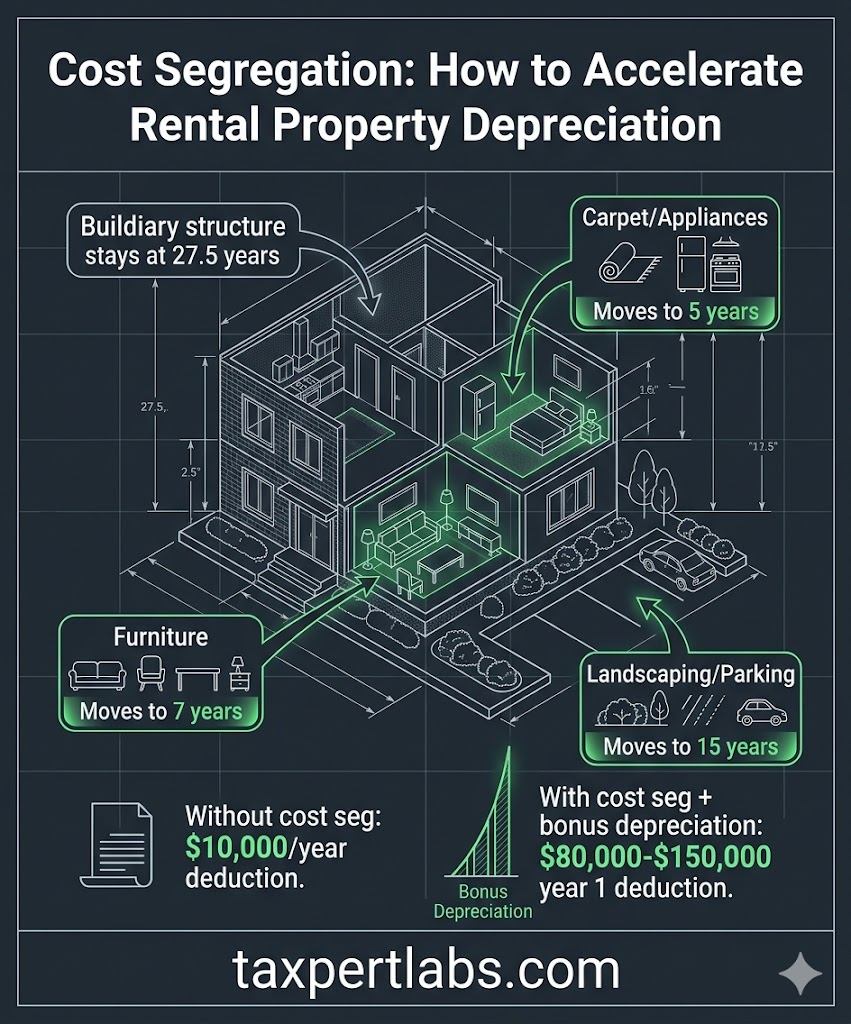
What Is Cost Segregation?
Cost segregation is an engineering-based tax strategy (recognized by the IRS under Rev. Proc. 87-56) that breaks a building into its component parts and assigns each component to the correct depreciation life:
- 5-year property: Carpeting, appliances, certain fixtures, decorative elements
- 7-year property: Office furniture, certain equipment
- 15-year property: Land improvements — parking lots, fencing, landscaping, driveways, outdoor lighting
- 27.5-year property: The building shell — walls, roof, structural components
Without a study, everything gets lumped into 27.5 years. With a study, a qualified engineering firm identifies every component that can be legally reclassified — often 20–40% of a property's value.
The Real Numbers: A Fort Lauderdale Property
Let's look at a $1.5M waterfront rental property in Fort Lauderdale:
| Without Cost Seg | With Cost Seg + Bonus Depreciation |
|---|---|
| Year 1 depreciation: $54,000 | Year 1 depreciation: $280,000–$400,000 |
| Tax savings at 37%: ~$20,000 | Tax savings at 37%: $103,000–$148,000 |
| Remaining depreciable life: 27.5 years | Front-loaded: massive Year 1 benefit |
The difference is $83,000–$128,000 in additional Year 1 tax savings — on a single property.
Why South Florida Properties Are Perfect for Cost Segregation
1. High Property Values = Massive Reclassifiable Basis
Cost segregation's benefit scales with property value. Fort Lauderdale, Miami, Palm Beach, and Boca Raton properties regularly transact at $1M–$10M+. Higher value = more reclassifiable components = larger deductions. A $5M commercial property in downtown Fort Lauderdale could yield $800,000–$1.5M in accelerated deductions.
2. Short-Term Rental Market
Fort Lauderdale Beach, Miami, and the Keys have thriving short-term rental markets. STR properties often have higher-value personal property components (furnishings, appliances, entertainment systems, outdoor fixtures) that reclassify to 5-year or 7-year property. This increases the reclassifiable percentage compared to a standard long-term rental.
3. New Construction and Renovation Activity
South Florida is one of the most active construction markets in the country. New construction and recent renovations are ideal cost segregation candidates — studies are most accurate and most valuable when performed at acquisition or shortly after a major renovation.
4. Commercial Real Estate Density
Broward and Miami-Dade counties have dense commercial real estate — office buildings, retail centers, warehouses, and mixed-use developments. Commercial properties (39-year default) have even more to gain from cost segregation than residential properties.
Bonus Depreciation: The Multiplier
Cost segregation alone is powerful. Combined with bonus depreciation under IRC §168(k), it becomes transformative.
Bonus depreciation allows you to immediately expense 100% of the cost of qualifying property (5-year and 7-year components) in the year it's placed in service, rather than spreading it over the depreciation schedule.
2026 bonus depreciation rates to know:
- 2025: 40% bonus depreciation on qualifying property
- 2026: 20% bonus depreciation (continuing phase-down)
- 2027+: 0% (unless Congress extends)
This means 2025 and 2026 may be your last years to capture meaningful bonus depreciation. A cost segregation study performed today — on your existing properties — captures these rates before they phase out entirely.
Cost Segregation + REPS: The Power Stack
Here's where South Florida real estate investors can unlock truly transformative savings. Cost segregation creates massive paper losses from accelerated depreciation. Real Estate Professional Status (REPS) turns those passive losses into deductions against your ordinary income — W-2, business, investments.
| Strategy | Without REPS | With REPS |
|---|---|---|
| $400K cost seg deduction | Passive loss — can't offset W-2 income | $400K deduction against all income |
| Tax savings at 37% | $0 current year (carries forward) | $148,000 current year |
For a Fort Lauderdale dual-income household — one spouse earning $500K in W-2 income, the other qualifying for REPS by managing a rental portfolio — cost segregation + REPS can generate $100,000–$200,000+ in real tax savings in a single year.
The Look-Back Study: Capturing Missed Depreciation
Own a property for 3, 5, or even 10 years without doing a cost segregation study? You haven't lost those deductions.
A look-back cost segregation study combined with a Form 3115 (Change in Accounting Method) filing allows you to catch up on all missed accelerated depreciation in a single tax year — without amending prior returns.
This is one of the most overlooked strategies for South Florida investors who acquired properties before the bonus depreciation era or simply never had a study done. A property purchased in 2015 for $800,000 could generate a $150,000–$300,000 catch-up deduction on this year's return.
When Does Cost Segregation Make Sense?
Ideal Candidates
- Property value $500K+ — The study cost ($3,000–$15,000) should be clearly justified by expected savings
- Taxable income $200K+ — You need meaningful income to absorb the deductions
- Properties held 2+ years without a study — Look-back opportunity
- Recent acquisitions or renovations — Best time to capture accurate reclassification
- Short-term rentals — Higher personal property percentage increases benefit
- REPS qualifiers — Losses are immediately usable, not just carryforwards
When to Wait
- Low-income years — If you expect significantly higher income next year, consider timing
- Planned near-term sale — Depreciation recapture at sale (25% rate) needs to be factored in
- Properties below $300K — ROI may not justify study cost
Depreciation Recapture: The One Catch
When you eventually sell the property, the IRS recaptures accelerated depreciation at a maximum 25% rate (Section 1250 recapture). This is real and needs to be in your calculation.
However, there are strategies to manage or defer recapture:
- 1031 Exchange — Defer both capital gains and depreciation recapture by reinvesting in a like-kind property
- Installment sale — Spread recognition over multiple years
- Estate planning — Stepped-up basis at death eliminates accumulated depreciation recapture
- Qualified Opportunity Zone investment — South Florida has multiple QOZ locations; reinvesting gains defers and partially excludes them
The math still strongly favors cost segregation for most Fort Lauderdale investors. Getting $148,000 in tax savings today — and paying $25,000 in recapture in 10 years (in inflated dollars) — is an excellent trade.
How to Get a Cost Segregation Study
- Use a qualified engineering firm — Not a generic CPA service. Look for firms that employ licensed engineers and have IRS audit defense experience.
- Provide property documentation — Purchase agreement, closing statement, blueprints/floor plans if available, list of improvements
- Review the component list — The study should itemize every reclassified component with justification
- Coordinate with your CPA — The study output needs to be properly reported on Form 4562 and integrated with your return
- File Form 3115 if doing a look-back — This is filed with your current-year return to catch up prior years
For South Florida properties, expect study costs of $3,000–$8,000 for residential and $5,000–$15,000 for commercial properties. On a $1.5M property, that's a 1,000%+ ROI in Year 1.
Run your free tax assessment to see whether a cost segregation study makes sense for your South Florida portfolio — and how it stacks with your other strategies.
Related Reading
See How Much You're Overpaying
Run a free 2-minute assessment and get your personalized tax leak report — with IRS-backed strategies and IRC code citations.
Run My Free Assessment